Comparison
eSIM or Starlink? What pays off when
Where there's mobile coverage, the eSIM nearly always wins. Where there isn't, Starlink comes into its own. A decision guide for your trip type.
Contents
This article contains advertising (affiliate) links, marked “Ad”. How we label ads
In short: A travel eSIM is cheaper, smaller and works wherever there is mobile coverage – on the bus, in town, on the beach. Starlink needs setting up, a clear view of the sky and power, but delivers internet where mobile coverage is missing or overloaded. Many travellers combine both. As of October 2026.
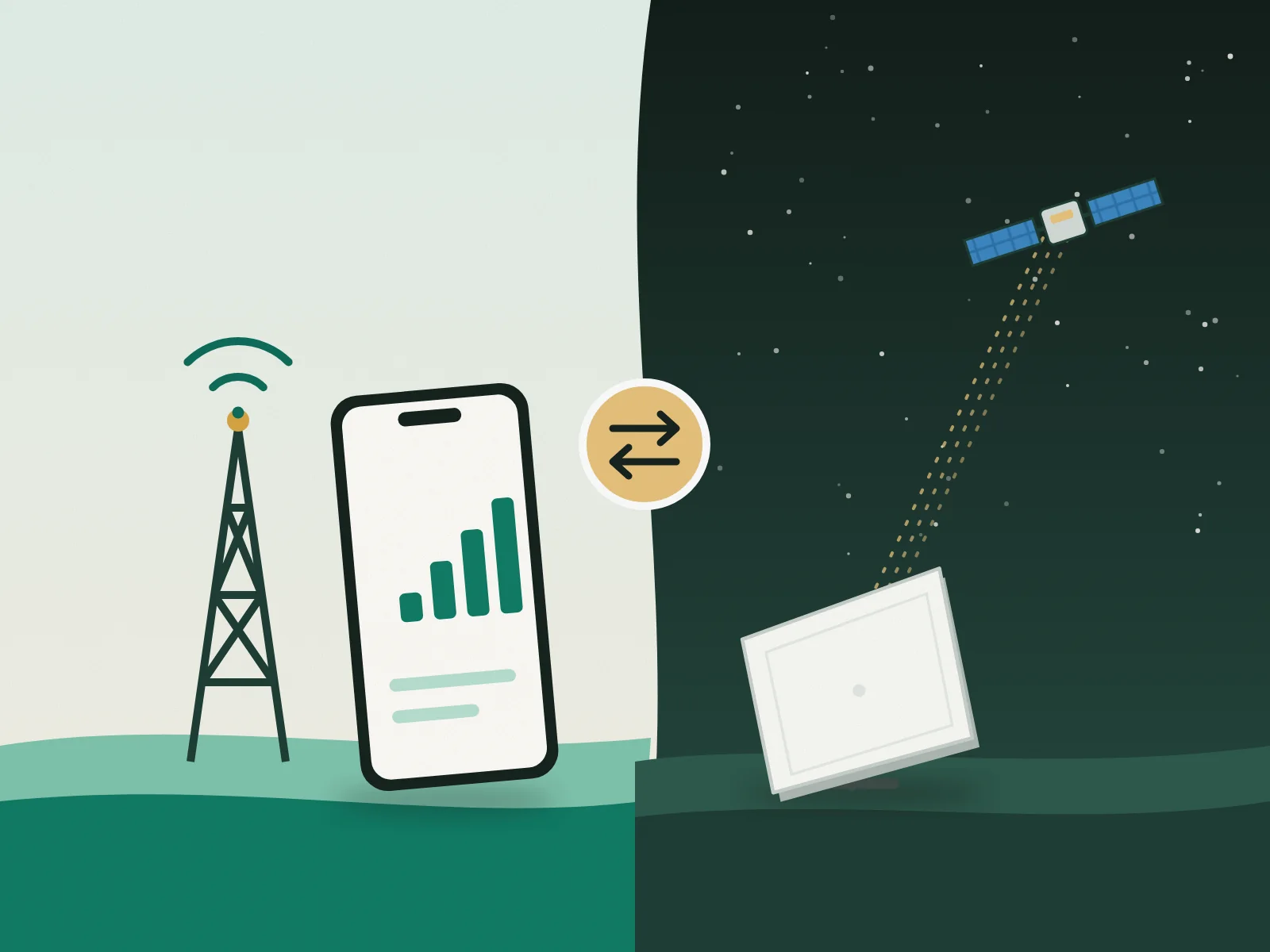
Two completely different technologies
An eSIM uses local mobile networks. It is only as good as the network: often fast in cities, patchy in the countryside, and sometimes absent in mountain valleys, on islands and remote beaches. In return it costs little, weighs nothing and works on the move.
Starlink connects to satellites in low orbit via its own antenna. That works independently of cell towers – as long as the antenna has a clear view of the sky, has power and Starlink is licensed in the country. The price: hardware, a monthly plan, setup, and an average draw of 25–40 W for the Mini.
The comparison
| Criterion | Travel eSIM | Starlink Mini |
|---|---|---|
| Requirement | Mobile network, eSIM-capable phone | Clear view of the sky, power (avg 25–40 W) |
| Cost | Data pack per country/region | Hardware plus monthly roam plan |
| Effort | Scan a QR code | Set up, align, power |
| Weight | 0 g | about 1.1 kg plus cable/battery |
| On the move | Works while moving | Only with suitable plans/conditions |
| Rules | Validity/data of the pack | 30-day rule outside your home region |
| Strength | Cities, round trips, bus rides | Dead zones, camper, cabin, beach, boat |
| Weakness | No network = no internet | Trees/roofs, power hungry, cost |
What does it cost? (orders of magnitude)
Exact prices change constantly – always check with the provider. As a guide:
- eSIM: For a two-week trip to one country you typically pay a low to mid double-digit euro amount, depending on data. Day-based unlimited plans cost more than small GB packs but save you counting.
- Starlink: On top of the hardware (Mini kit) comes a monthly roam plan. Starlink offers roam plans in several tiers, depending on the country e.g. 100 GB, 300 GB or unlimited. Current prices appear at checkout on starlink.com with your address. Details: Starlink Mini for travel – costs, plans, pausing.
For a single holiday with good coverage the eSIM is almost always many times cheaper. Starlink pays off if you’re regularly in places without reliable mobile coverage – or when a dropped video call costs you more than the plan.
Decision guide by trip type
| Trip type | Recommendation | Why |
|---|---|---|
| City break, round trip by bus/train | eSIM | Good coverage, works on the move, no luggage |
| Beach holiday in the EU | Home plan (EU roaming) | „Roam like at home“, check fair use |
| Remote work at a fixed place with good coverage | eSIM, Starlink only as backup | Calls usually run fine on 4G/5G |
| Camper, motorhome, pitches in nature | Starlink + eSIM | Many pitches have weak signal |
| Remote accommodation, beach without coverage | Starlink | Often the only option |
| Boat near the coast | Starlink + eSIM | eSIM in the marina, Starlink at anchor |
| Long trip outside Europe | eSIM as the base | Starlink: mind the 30-day rule – Starlink outside Europe – the 30-day rule and travel registration |
How much data do you need?
It depends on your usage: maps and messengers need a few hundred MB a week, video calls many times that per hour, HD streaming even more. Our eSIM data calculator works it out with openly stated assumptions.
Our own experience: for most trips we use a Holafly eSIM (13 since 2024, including the USA, Brazil, Malaysia, Morocco and the UK; code JANPEM4IDSKH gives 10% off). We pack the Starlink Mini when we head somewhere without reliable coverage – like Atins in Brazil: Internet in a dead zone – our setup in Atins (Lençóis Maranhenses).
Combining both: what many people do
- eSIM for navigation, messengers, ride-hailing and everything on the move
- Starlink for video calls, big uploads and workdays at your base
- Hotspot: if the eSIM pack allows tethering, the phone can supply the laptop too – see Travel eSIM explained – internet without swapping SIM cards
- Failover: if Starlink drops due to obstructions or a power cut, the phone hotspot steps in
Common misconceptions
- „Starlink is always faster.“ Not necessarily. In cities with good 5G, mobile is often on par – and far more convenient.
- „With Starlink I don’t need a SIM.“ In the car, on the bus or on foot you’re offline without mobile.
- „The eSIM works everywhere in the country.“ Only where the network used has signal. Local carriers’ coverage maps help.
- „Starlink works everywhere.“ Only in countries where it’s licensed – see Countries with Starlink coverage – and where it’s not allowed.
- Forgetting power: the Mini needs a 100 W USB-C PD or 12 V source – Powering the Starlink Mini on the road – power bank, power station, solar.
FAQ
Is Starlink faster than an eSIM when travelling?
It depends on the place. In cities with good 4G/5G, mobile is often equal and far more convenient. In dead zones, Starlink is often the only option.
Do you need both?
Not necessarily. For most trips an eSIM is enough. Starlink pays off if you’re regularly where mobile coverage is missing – in a camper, on a boat or in remote accommodation.
Can I take Starlink on a plane?
The Mini, yes – it has no built-in battery. Your power bank is subject to the airline’s battery rules. More in Powering the Starlink Mini on the road – power bank, power station, solar.
Is there a minimum term with Starlink?
Roam plans are monthly. Between trips you can switch to Standby: Pausing Starlink – Standby Mode explained.
Read next
Starlink
Starlink Mini for travel – costs, plans, pausing
What the Mini can do, what it costs per month, why a 30-day limit applies outside Europe since summer 2026 – and how to let the service rest cheaply between trips.
Power
Powering the Starlink Mini on the road – power bank, power station, solar
The Mini draws 25–40 watts on average. What that means for power banks, power stations and solar – with a simple formula and a runtime table.
Starlink
Buying a Starlink Mini in Austria – direct, retail, referral link
Directly from Starlink or from an electronics retailer? What to know before buying the Starlink Mini in Austria – from price to activation.