Power
Powering the Starlink Mini on the road – power bank, power station, solar
The Mini draws 25–40 watts on average. What that means for power banks, power stations and solar – with a simple formula and a runtime table.
Contents
- How much power does the Starlink Mini need?
- USB-C Power Delivery: the most common source of error
- Work out the runtime yourself
- Example: how much power do you need per day?
- 12 volts in car and camper
- Power banks on planes
- Power station: for campers, boats and longer stays
- Solar: realistic expectations
- Cold, heat, sand
- Sockets in your accommodation: what to watch
- Caring for and storing batteries
- Our recommendation by trip type
- FAQ
- Sources
This article contains advertising (affiliate) links, marked “Ad”. How we label ads
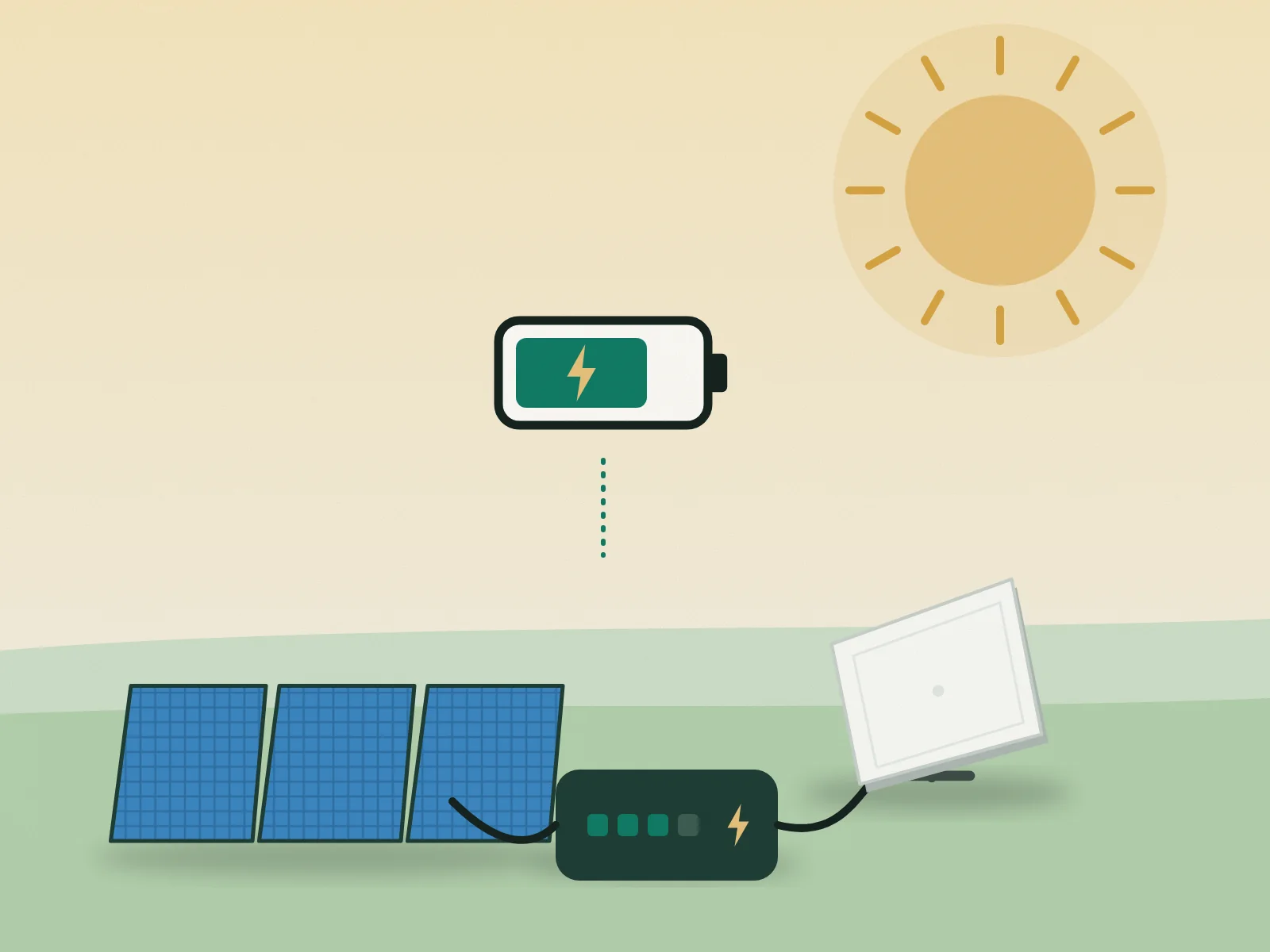
In short: According to the datasheet the Mini needs 12–48 V DC (60 W rated) and 25–40 W on average. Via USB-C it only works with a source delivering 100 W at 20 V/5 A, plus the right cable. Runtime ≈ usable watt-hours ÷ consumption. A 99 Wh power bank lasts roughly 2–3.5 hours on paper. As of October 2026.
How much power does the Starlink Mini need?
The official datasheet values: input voltage 12–48 V DC, rated power 60 W, average consumption 25–40 W. Actual consumption depends on how much data flows, how clear the view of the sky is and how cold it is. During start-up and with snow melt enabled it’s briefly higher according to accessory retailers’ measurements (40–60 W at start and 50–70 W when melting are cited) – those are retailer figures, not Starlink values.
USB-C Power Delivery: the most common source of error
Many people buy a powerful power bank and wonder why the Mini won’t start. The reason: it needs a USB-C PD source of at least 100 W, i.e. 20 V at 5 A. Phone chargers and many car adapters with 30 or 45 W aren’t enough. You also need a cable rated for 5 A and the USB-C to Mini barrel-plug adapter (Starlink sells its own USB-C cable).
- Power bank/charger: output „100 W“ or „20 V ⎓ 5 A“ on one port
- Cable: rated for 5 A / 100 W
- Adapter: USB-C to the Mini’s barrel plug
- Test at home before the trip – including start-up
Work out the runtime yourself
The formula is simple:
Runtime (h) ≈ capacity (Wh) × efficiency ÷ consumption (W)
We assume 85 % efficiency (conversion losses). If the power bank only states mAh: Wh = mAh × cell voltage (usually 3.6–3.7 V) ÷ 1,000.
| Power source | Capacity | at 25 W | at 40 W |
|---|---|---|---|
| Power bank (flight limit without approval) | 99 Wh | ≈ 3.4 h | ≈ 2.1 h |
| Large power bank (airline approval needed) | 160 Wh | ≈ 5.4 h | ≈ 3.4 h |
| Small power station | 300 Wh | ≈ 10 h | ≈ 6.4 h |
| Medium power station | 1,000 Wh | ≈ 34 h | ≈ 21 h |
Calculated at 85 % efficiency, without start-up peaks or snow melt. In the cold, usable capacity drops further.
Example: how much power do you need per day?
Instead of hours you can think in watt-hours per day. An example with openly stated assumptions:
Assume 4 hours of work a day with e-mail and video calls, 30 W average
4 h × 30 W = 120 Wh consumption
120 Wh ÷ 0.85 efficiency ≈ 141 Wh battery capacity per day
That’s more than one power bank at the 100 Wh flight limit. For such a workday you need two power banks, access to a socket for recharging, or a power station. The Mini is most efficient when you switch it on deliberately rather than running it all day. But remember: each start-up takes a few minutes and briefly needs more power. Try the power calculator.
12 volts in car and camper
In a vehicle you can connect the Mini directly to the on-board supply with a 12 V cable – its input accepts 12–48 V. Make sure cables are adequately sized and properly fused, as 40–60 W at 12 V means several amps. Long, thin cables cause voltage drop and the Mini may not start reliably. For fixed installations in a camper or boat a specialist workshop is the safe choice. More: Starlink Mini in a camper – mounting, 12-volt supply, use on the move.
Power banks on planes
Strict rules apply to lithium batteries in air travel: power banks go in hand luggage, not checked bags. Up to 100 Wh they’re usually allowed without approval, between 100 and 160 Wh only with the airline’s consent (usually at most two), above that not at all. Many airlines have recently tightened their rules: at the Lufthansa Group (which includes Austrian Airlines) power banks may neither be used nor charged on board since 15 January 2026, at most two are allowed, and they may not go in the overhead bin. Check your airline’s terms before every flight. Power stations with several hundred watt-hours are practically never allowed – they’re for campers, boats and cars.
Power station: for campers, boats and longer stays
If you stay longer somewhere without reliable power, a power station with a USB-C PD output (100 W) or 12 V output is the more convenient solution. Power the Mini directly with DC (USB-C PD or 12 V cable) rather than via the 230 V outlet and the original power supply – every extra conversion costs energy.
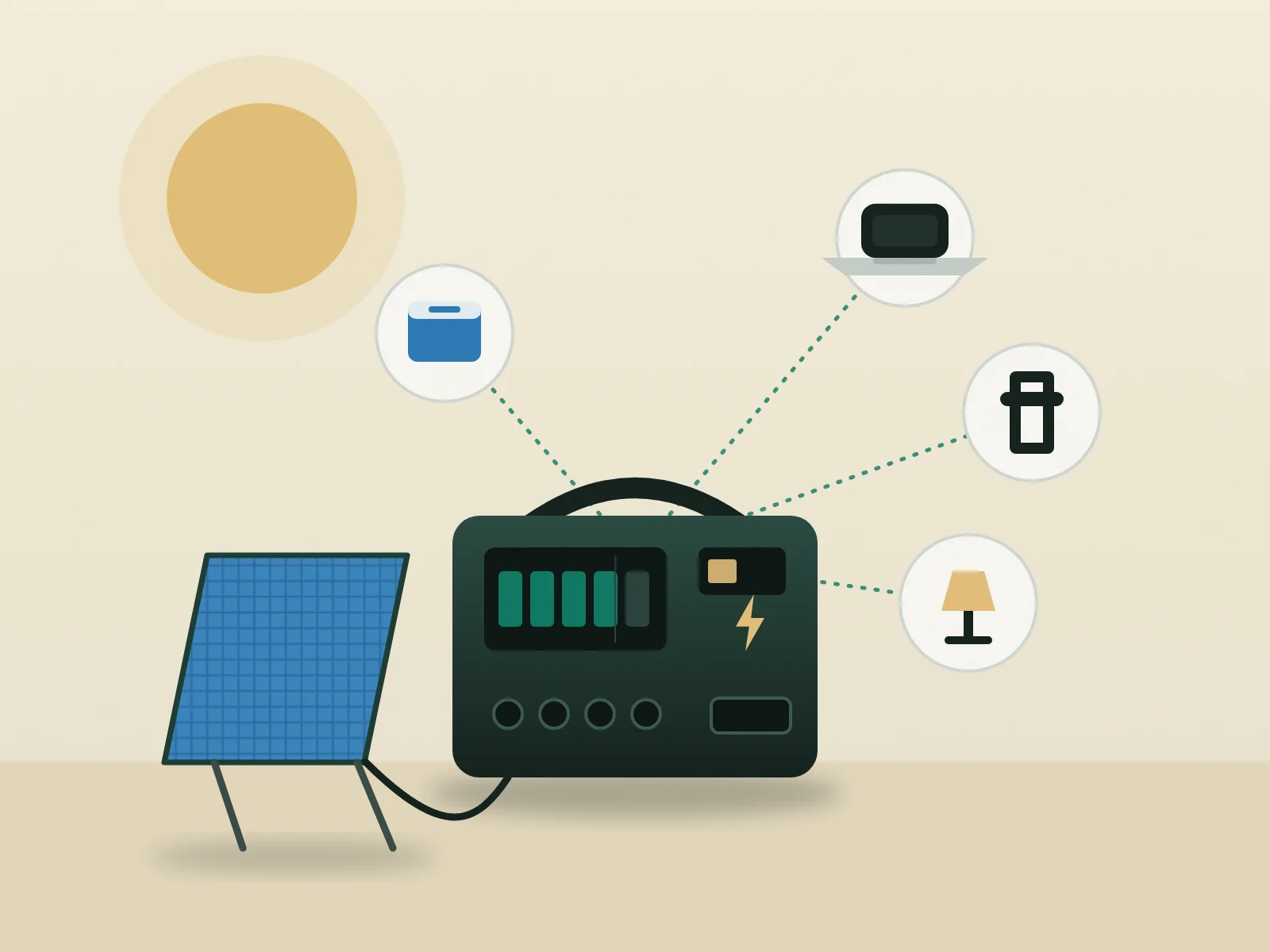
Power station for travel and camping – what size do you need? works out step by step which size suits you – or use the power calculator directly.
Solar: realistic expectations
A solar panel only delivers its rated power under ideal conditions. Clouds, low sun, heat, shade and the wrong angle reduce yield considerably. For planning, rely on what you’ve measured at your destination rather than the label on the panel. Rule of thumb: for a 30 W Mini to run several hours a day and recharge the battery, you need considerably more panel power than 30 W.
A simple estimate: daily need in Wh ÷ peak sun hours = required panel power. With the example above (141 Wh per day) and 4 peak hours that’s about 35 W – without any reserve for clouds, shade or charging losses. In practice you plan for a multiple of that, and at northern latitudes in winter solar provides hardly any usable power.
Cold, heat, sand
- Cold: the Mini is specified down to −30 °C, but batteries lose capacity in the cold. Many LiFePO4 batteries must not be charged below 0 °C – follow manufacturer guidance. Snow melt increases consumption.
- Heat: the datasheet states up to 50 °C. Keep power banks and power stations out of direct sun.
- Sand and water: IP67 only applies with cables plugged in. Keep connectors dry and free of sand.
Sockets in your accommodation: what to watch
Even where accommodation has power, it’s often unreliable in remote places: outages, voltage fluctuations, generator power at set hours. A few simple rules help:
- Check input voltage: every power supply states the range it accepts (e.g. „100–240 V“). Only then does it work in countries with different mains voltage.
- Bring the right travel adapter for sockets at your destination.
- Plan a buffer: a charged power bank bridges outages so the important call doesn’t drop.
- Charge when power is available: with generator power, charge every battery during those hours.
Caring for and storing batteries
Lithium batteries last longer if they aren’t stored permanently full or completely empty and aren’t exposed to great heat. For longer breaks between trips many manufacturers recommend a medium state of charge. Read your manufacturer’s guidance – it varies by cell chemistry.
Our recommendation by trip type
| Trip type | Power solution | Watch out for |
|---|---|---|
| Air travel, a few hours online per day | Power bank up to 100 Wh with 100 W USB-C PD | Airline rules, 5 A cable |
| Accommodation with (unreliable) power | Power supply plus power bank as buffer | 100–240 V input, travel adapter |
| Car and camper | 12 V cable directly on the vehicle supply | Cable size, fusing |
| Longer stays off-grid | Power station, possibly with solar | Capacity per daily need, plan solar generously |
FAQ
Will a normal laptop charger run the Mini?
Only if it delivers 100 W at 20 V/5 A on USB-C and you use a 5 A cable plus the right adapter. Many laptop chargers deliver 65 W – not enough.
Can I run the Mini from a car’s USB port?
Usually not – built-in USB ports deliver far less than 100 W. Use a 12 V cable or a 100 W USB-C PD car charger.
How long does a 1,000 Wh power station last?
On paper about 21–34 hours at 25–40 W and 85 % efficiency – without other devices.
Sources
Read next
Power
Power station for travel and camping – what size do you need?
300, 500 or 1,000 watt-hours? Instead of buying by gut feeling, calculate your needs in five minutes.
Starlink
Starlink Mini for travel – costs, plans, pausing
What the Mini can do, what it costs per month, why a 30-day limit applies outside Europe since summer 2026 – and how to let the service rest cheaply between trips.

Starlink
Buying a Starlink Mini in Austria – direct, retail, referral link
Directly from Starlink or from an electronics retailer? What to know before buying the Starlink Mini in Austria – from price to activation.