Power
Power station for travel and camping – what size do you need?
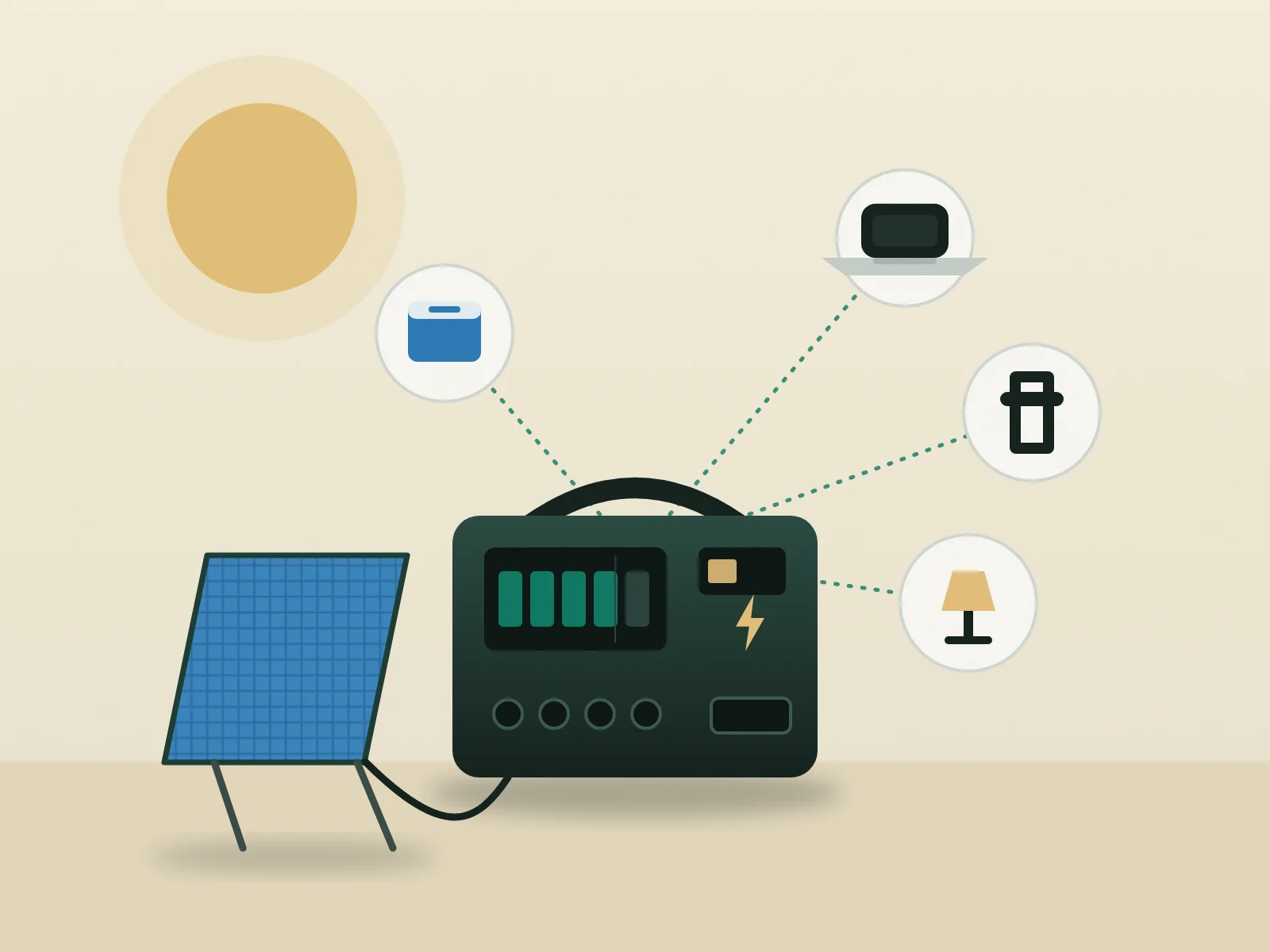
300, 500 or 1,000 watt-hours? Instead of buying by gut feeling, calculate your needs in five minutes.
Contents
This article contains advertising (affiliate) links, marked “Ad”. How we label ads
In short: Add up the daily consumption of all devices in watt-hours (watts × hours), divide by efficiency (assumed 85 %), multiply by days without recharging and add a reserve. Result = minimum capacity in Wh. Calculate directly: power calculator. As of October 2026.
The three numbers that matter
Power station spec sheets are full of figures. Three really count:
| Spec | Unit | What it means |
|---|---|---|
| Capacity | Wh (watt-hours) | How much energy is stored – determines how long your devices run |
| Continuous output | W (watts) | How much power can be delivered at once – determines which devices run at all |
| Charging power | W | How quickly the station refills from mains, car or solar |
A 1,000 Wh station with only 300 W output won’t run a kettle – and a 2,000 W station with 250 Wh capacity is empty in no time.
The formula
Capacity (Wh) ≈ Σ (watts × hours) ÷ efficiency × days × (1 + reserve)
- Watts: the device’s average draw (not the peak rating on its power supply).
- Hours: how long it runs per day.
- Efficiency: conversion losses. Via the 230 V inverter 10–20 % is often lost, via USB-C or 12 V less. We assume 85 %.
- Days: how long you want to last without recharging.
- Reserve: buffer for cold, ageing and the unexpected, e.g. 20 %.
Step by step
- List the devices you want to run on the road.
- Find each device’s average power – datasheet, plug-in power meter or the power station’s display.
- Estimate daily runtime honestly.
- Calculate watt-hours per device and add them up.
- Divide by efficiency, multiply by days and reserve.
- Check continuous output: the sum of devices running at the same time must stay below the station’s rating.
Worked example (assumptions)
| Device | Watts (avg) | Hours/day | Wh |
|---|---|---|---|
| Starlink Mini | 30 | 5 | 150 |
| Laptop | 45 | 5 | 225 |
| Phone charging | 10 | 2 | 20 |
| Total | 395 |
395 Wh ÷ 0.85 ≈ 465 Wh per day. For 2 days without recharging plus 20 % reserve: 465 × 2 × 1.2 ≈ 1,116 Wh.
Second example: a camper weekend
| Device | Watts (avg) | Hours/day | Wh |
|---|---|---|---|
| Compressor cool box | 15 (daily average) | 24 | 360 |
| LED light | 10 | 4 | 40 |
| Starlink Mini | 30 | 3 | 90 |
| Phones/tablet | 15 | 2 | 30 |
| Total | 520 |
520 Wh ÷ 0.85 ≈ 612 Wh per day. For a weekend (2 days) with 20 % reserve: ≈ 1,470 Wh – or less capacity plus a solar panel. The cool box is the biggest item here; its real consumption depends heavily on outside temperature and insulation.
Typical consumption values
These are rough guide values – measure yourself if in doubt.
| Device | Typical power |
|---|---|
| Starlink Mini | 25–40 W average per datasheet |
| Laptop (office work) | 30–60 W |
| Smartphone charging | 5–20 W |
| Mobile 4G/5G router | 5–15 W |
| Compressor cool box | 30–60 W while running, much less averaged over the day |
| LED lamp | 5–15 W |
| Kettle, hair dryer | 1,000–2,000 W – unsuitable for small stations |
What to look for when buying
- DC outputs: 100 W USB-C PD and a 12 V port avoid conversion losses compared with the 230 V outlet. Ideal for the Starlink Mini.
- Cell chemistry: LiFePO4 is designed for many charge cycles but heavier; compare manufacturer data.
- Charging: mains, car (12 V) and solar input – including maximum solar input voltage.
- Cold: many LiFePO4 batteries must not be charged below 0 °C.
- Weight: from about 1,000 Wh it gets heavy to carry – irrelevant in a camper, relevant on foot.
- Flights: power stations with several hundred Wh are practically never allowed.
- Expandability: some models accept extra batteries.
Brands compared
| Brand | Typical range | Watch out for |
|---|---|---|
| EcoFlow | Wide range, many with USB-C PD | Output per port, app required? |
| Anker SOLIX | Portable stations and solar panels | Weight vs capacity |
| Jackery | Power stations and foldable panels | Charging times, ports |
We don’t cite test results we haven’t produced ourselves. Compare datasheets for capacity (Wh), continuous output (W) and ports.
Planning solar realistically
Required panel power ≈ daily need ÷ peak sun hours ÷ (1 − losses). With 465 Wh, 4 peak hours and 25 % losses: ≈ 155 W. A panel only delivers its rated power under ideal conditions – low sun, clouds, heat and shade cost a lot. At northern latitudes in winter, solar provides hardly any usable power. More on powering the Mini: Powering the Starlink Mini on the road – power bank, power station, solar.
Common mistakes
- Using peak instead of average power – the result is far too large.
- Forgetting efficiency – the station runs out sooner than expected.
- Running everything via 230 V – USB-C and 12 V are more efficient.
- Not checking continuous output – the device won’t start or the station shuts down.
- Overestimating solar – the panel’s rating is a lab value.
FAQ
Is a 300 Wh power station enough for the Starlink Mini?
On paper for about 6–10 hours of operation (at 25–40 W and 85 % efficiency). Whether that’s enough depends on your daily needs.
Ah or Wh – which counts?
Wh. Ah figures aren’t comparable without voltage: Wh = Ah × volts.
Can I use the power station while charging?
Many models support pass-through charging. Check the datasheet – and whether continuous use that way is recommended.
How do I store it between trips?
Cool, dry and at a medium state of charge – many manufacturers recommend topping up every few months.
Read next
Power
Powering the Starlink Mini on the road – power bank, power station, solar
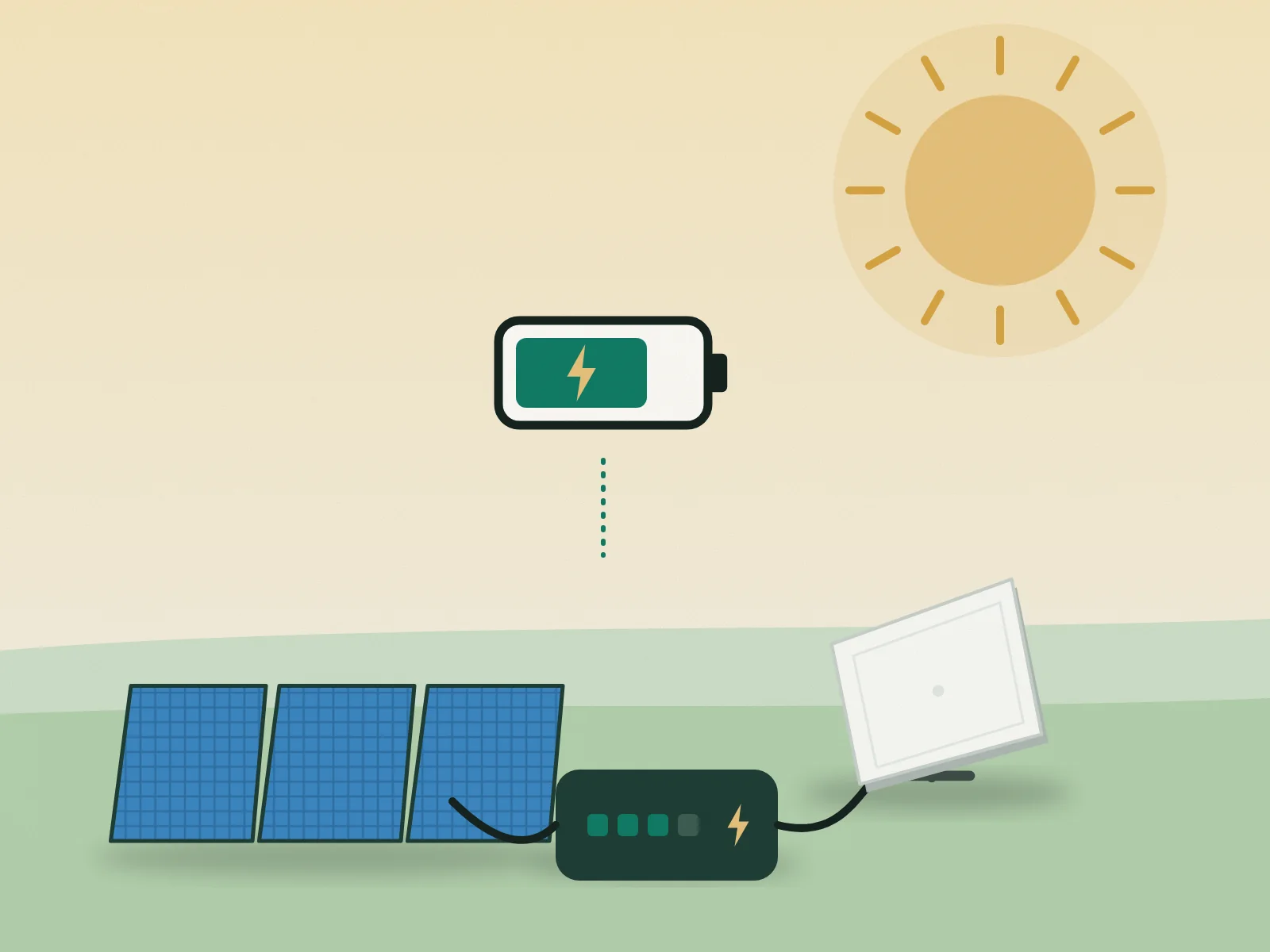
The Mini draws 25–40 watts on average. What that means for power banks, power stations and solar – with a simple formula and a runtime table.

Starlink
Starlink Mini for travel – costs, plans, pausing
What the Mini can do, what it costs per month, why a 30-day limit applies outside Europe since summer 2026 – and how to let the service rest cheaply between trips.

Starlink
Buying a Starlink Mini in Austria – direct, retail, referral link
Directly from Starlink or from an electronics retailer? What to know before buying the Starlink Mini in Austria – from price to activation.